Multi-store commerce
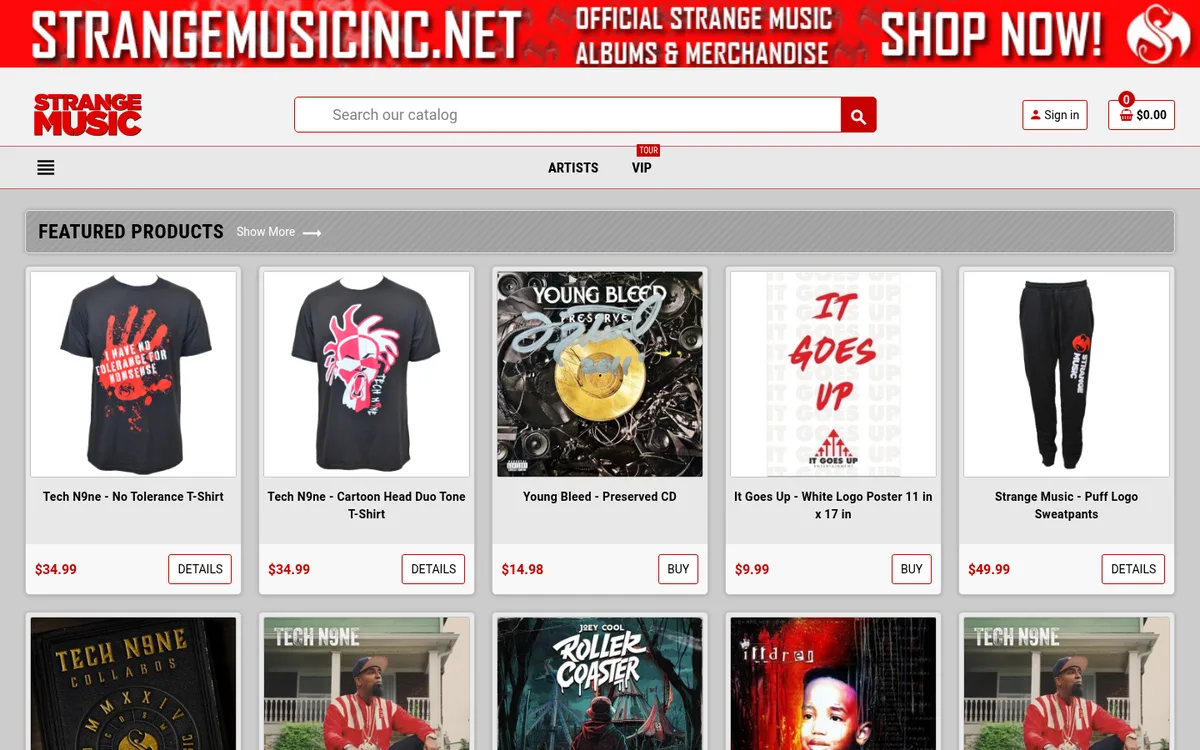
A merch and VIP platform spanning several active storefronts — product publishing, catalog management, and checkout kept healthy through weekly launches.
Sole IT for one of independent hip-hop’s biggest labels — the public blog and tour presence, a multi-store merch and VIP commerce operation, international tax automation, shipping workflows, and the monitoring that keeps it all quietly running.

This case page checks its own route brief, public freshness score, and visitor-route signal before asking anyone to trust the story.
Loading the citation-safe case brief.
Snapshot pendingStrange Music runs a public blog, a tour presence, and a multi-store merchandise and VIP operation that ships worldwide. I’m the single IT function behind it — the person who keeps the storefronts up, the orders flowing, the taxes filed correctly, and the launches landing on schedule.
It’s the kind of role where success is invisible: when it works, fans buy merch and never think about the machinery. My job is to make sure they never have to.
Strange Music was founded in 2000 by Kansas City rapper Tech N9ne and businessman Travis O’Guin, working out of O’Guin’s basement to get Tech’s music heard on their own terms. The name nods to The Doors. The bet — that an artist could build a real company without a major label — turned into one of the most successful independent record labels in the world.
Today the operation runs out of a multi-building campus in Lee’s Summit, just outside KC: recording studios, a screen-printing shop, warehousing and fulfillment, offices, and a state-of-the-art soundstage. (That soundstage is its own project on this site — The Soundstage at Strangeland.) It’s a real, physical business with a worldwide fanbase — and the commerce, tax, and web surfaces behind it are what I keep running.

The label is led by founder Tech N9ne — one of the most successful independent rappers ever, with well over a million monthly listeners — alongside a deep roster of current and legacy artists. Its subsidiary, It Goes Up Entertainment, is home to Saigon, SkyDxddy, and Phoenix duo unConventionAl KingZ — all three of which are storefronts I run, so the whole family ties back to one operation.
























Listen & follow
A real storefront isn’t one system — it’s a dozen interlocking ones. Product catalogs across multiple shops. Payment processing that has to stay PCI-compliant. International orders that trigger VAT obligations in several jurisdictions. Shipping that has to actually reach the customer. And a weekly drumbeat of drops that all have to go live without breaking checkout.
Any one of those going wrong costs real money or real trust. The work is keeping all of them boring at once.
A merch and VIP platform spanning several active storefronts — product publishing, catalog management, and checkout kept healthy through weekly launches.
Automated reconciliation of committed tax documents against the order database, covering IOSS / OSS / VAT obligations for EU and international sales — the unglamorous compliance that keeps cross-border selling legal.
Payment-to-fulfillment flow with order approval, shipping workflows, and storefront/platform sync so what sells online actually gets picked, packed, and shipped.
Error monitoring across storefronts, recurring PCI scans, and annual compliance filing — so problems surface before customers hit them and the operation stays audit-ready.
Cross-border VAT isn’t “close enough.” The reconciliation pipeline matches committed tax documents against actual orders so filings are correct to the line — no manual spreadsheet archaeology at month-end.
New products go live on a schedule fans watch closely. Launches have to publish cleanly without taking checkout down — staged, verified, and reversible.
PCI scope, payment security, and annual attestation are usually a team’s job. Keeping them green as a single operator means automating the evidence and locking down the surface area.
The catalog spans a label whose flagship artist alone draws well over a million monthly listeners, with a deep roster behind him — so the commerce platform has to scale from headliner drops to catalog back-titles without flinching. Revenue, order volume, and customer counts stay private to the client.
Battle-tested e-commerce foundations over anything trendy — reliability matters more than novelty when money moves through it.
Scripts that turn month-end tax work and order triage from manual hours into automated minutes.
Visibility and security so a one-person IT function can hold the line a whole team usually covers.
The current headline project is a ground-up rebuild of the public blog — a modern Next.js front end over a headless WordPress CMS, with per-artist pages that pull live Spotify and YouTube media, a full venue and tour-date layer, and search built straight into the site. It replaces an aging stack with something fast, structured, and far easier to keep current.
Underneath, the throughline never changes: remove manual work from the operation — more automated reconciliation, more self-healing monitoring, fewer launch-day surprises.
The blog and storefront are live — or browse the rest of the work.