Context stays fragmented.
A model can answer a prompt, but it does not naturally know the calendar, money picture, family/work relationships, infrastructure state, or the last ten private decisions unless that context is deliberately wired in.
A native AI synthesis layer built around one household instead of a generic chatbot: memory, calendar, finances, people, infrastructure, voice, images, and tools in one private loop.
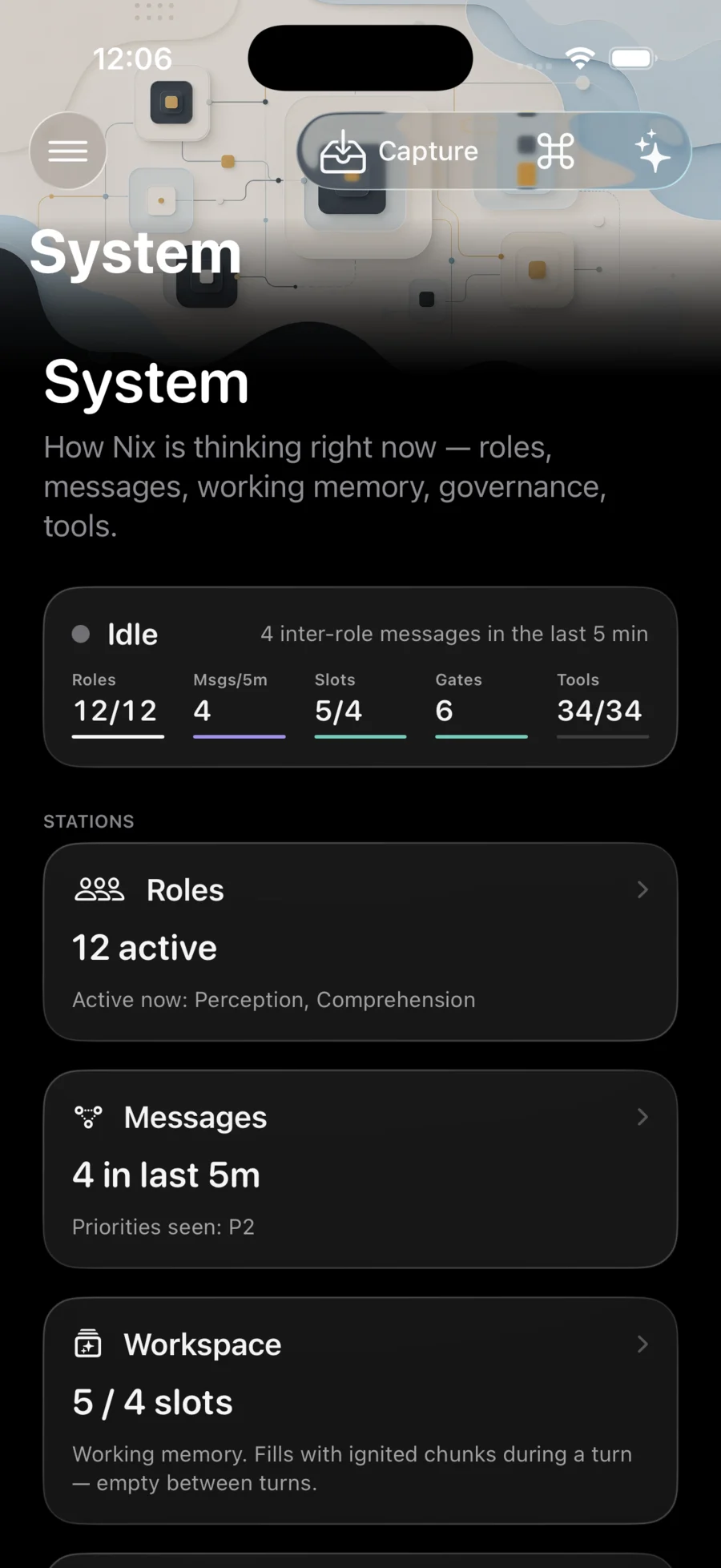
This case page exposes a public-safe route brief and aggregate route interest, but it does not expose household data.
Loading the citation-safe case brief.
Snapshot pendingNix V3 starts from a blunt premise: if we can write software, and AI can help us keep writing better software, we do not have to wait for some app store product to understand our home, tools, work, habits, or constraints.
It is a private synthesis layer for me and my wife. The point is not a broad consumer app. The point is a system that knows the context generic assistants never get: the household schedule, money questions, people graph, infrastructure state, creative pipeline, project memory, and the tools allowed to act on our behalf.
That is why it feels closer to a personal command layer than a chatbot. The app is not just answering. It is reading state, asking for permission, routing work through tools, remembering what matters, and showing its reasoning traces so we can tell when it is useful and when it needs correction.
A model can answer a prompt, but it does not naturally know the calendar, money picture, family/work relationships, infrastructure state, or the last ten private decisions unless that context is deliberately wired in.
Most assistants ask for broad cloud integrations. Nix uses explicit local gates: show the intent, show the risk, ask for permission, then run the tool through owned infrastructure.
When the system is centered around AI from the start, better models improve more than the answers. They improve the app, the workflows, the memory layer, and the automation around it.
These are real app captures from the current native line, trimmed to surfaces that do not expose private calendar details, finance values, raw memories, or personal contacts.
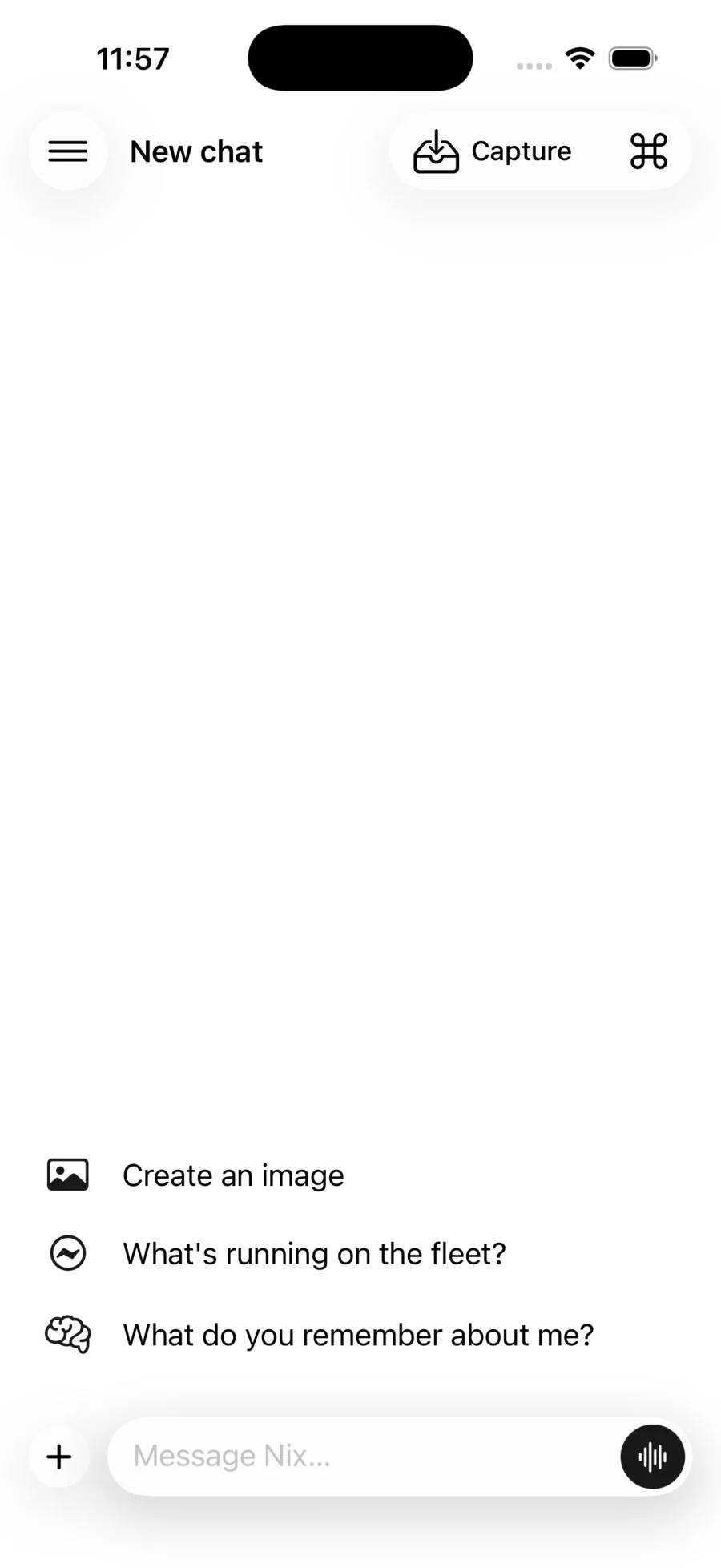
SwiftUI across iPhone, iPad, and Mac with a Liquid Glass design system, command palette, traces, tools, memory, governance, messages, and voice.
Server-side Swift in k3s handles passkeys, sessions, APNs device registration, shared sessions, event logs, and model routing.
GPT, Claude, realtime voice, whisper, and image generation route through the system’s authenticated tool layer instead of static API keys.
Calendar, finance context, people memory, infrastructure commands, file/image creation, and household workflows sit behind gates that keep the app useful and accountable.
The advantage is not that Nix tries to be smarter than every public AI product. The advantage is that it is allowed to be narrow. It knows the private surface area a generic app cannot safely assume: household priorities, recurring decisions, trusted people, projects in flight, the machines it can touch, and which actions need a human gate.
That makes the app less like a prompt box and more like a synthesis layer. One question can cross schedule, infrastructure, memory, creative work, and the current state of the fleet because those are not separate products inside our life. They are one life.
The shift is simple: instead of wishing a very specific piece of software existed, we build it around the exact life it needs to serve.
This case study describes the system dynamics. It does not publish calendars, financial values, contact graphs, raw memories, session transcripts, or credentials.
The UI is designed to show when Nix is about to touch sensitive areas and to make consent part of the workflow, not a hidden afterthought.
The bridge, event log, fleet tooling, and app state run through systems we control, which keeps the architecture inspectable and adaptable.
This page fills the missing public explanation between the S.A.M fleet and the Nix identity page. S.A.M is the substrate. Nix V3 is the lived interface: the iPhone, iPad, and Mac layer where the private system becomes usable.
The next useful public additions are a sanitized architecture diagram, a short safety/governance explainer, and a live build-status panel that reports aggregate app/bridge state without leaking private session data.
Nix V3 only works because the fleet, public sites, and model tooling are already treated as one owned platform.