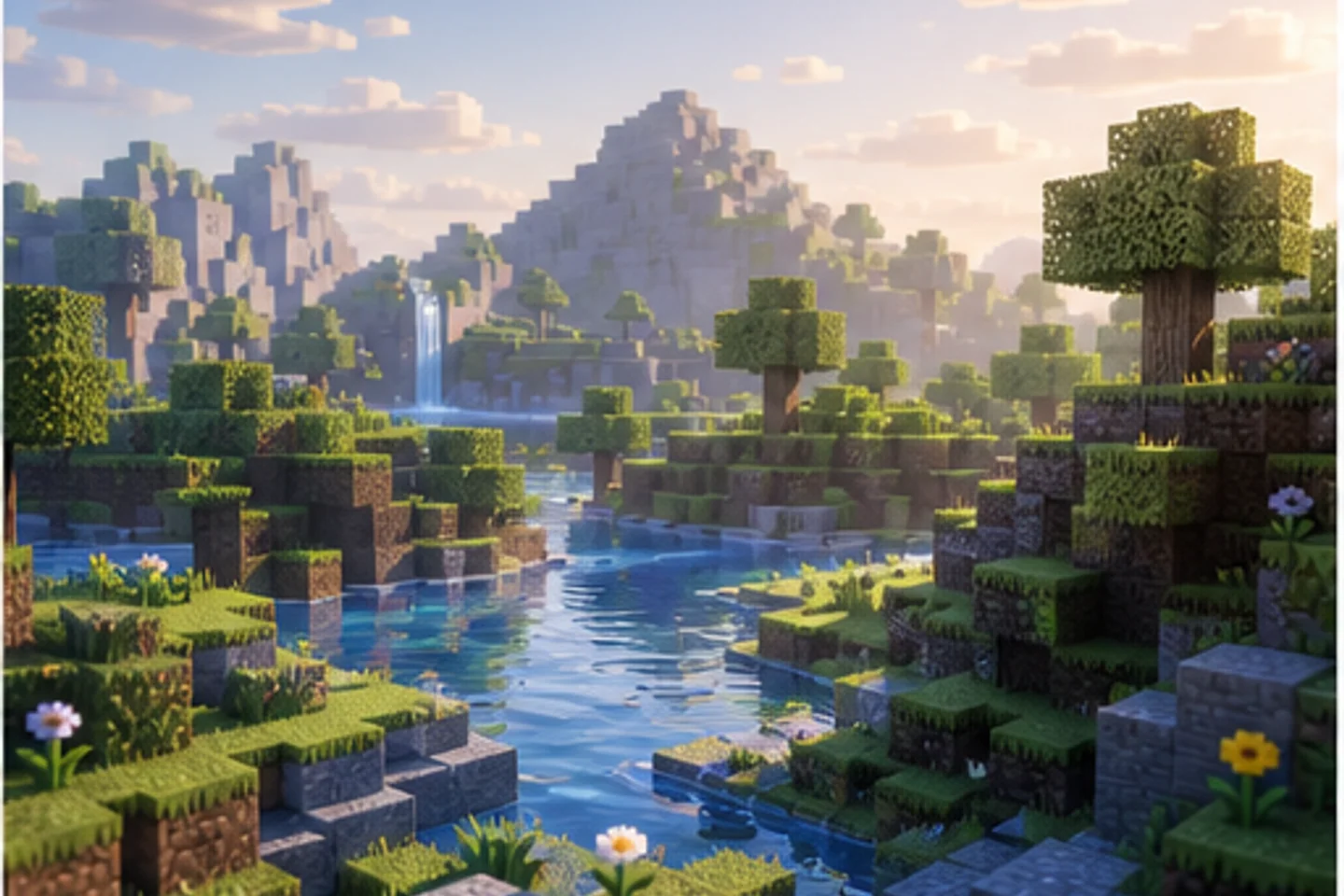
A living voxel world
Procedural terrain with real landmarks — cabins, watchtowers, ruins, wells — a day/night cycle with dynamic lighting, passive and hostile mobs, and a survival loop with combat and drops.
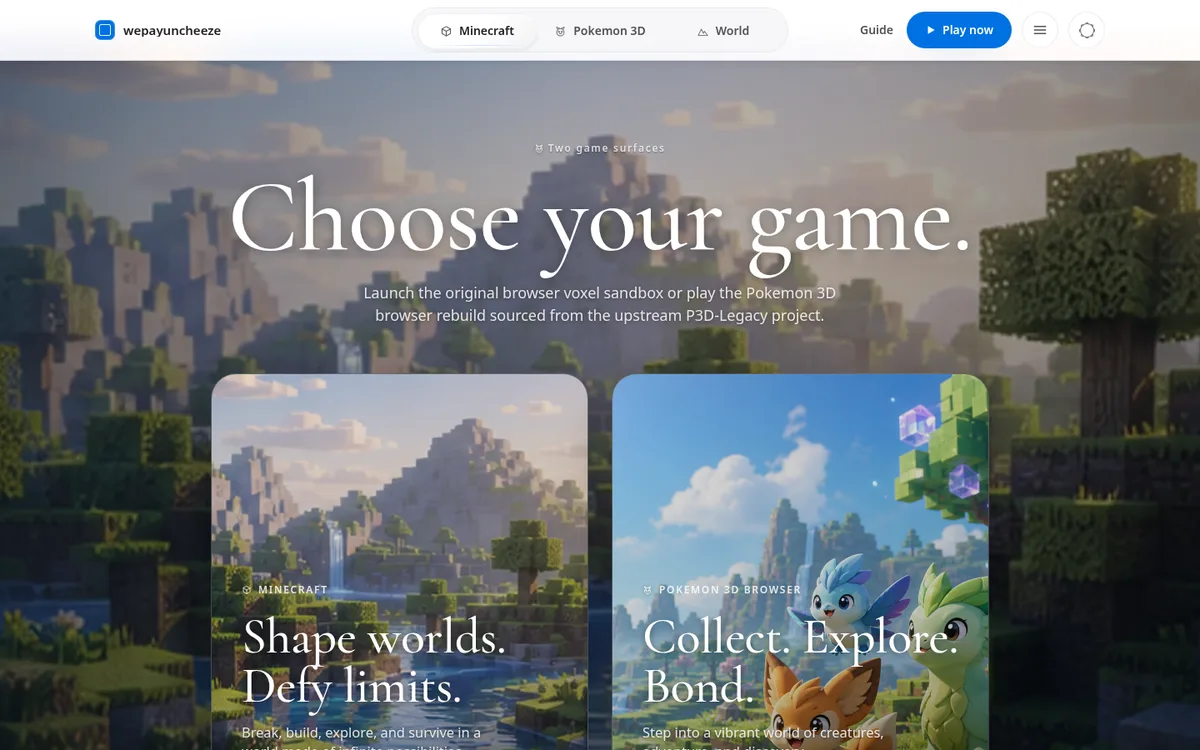
I’m a 90s kid — Pokémon and Minecraft basically raised me, and I always wondered how the people who made them actually pulled it off. This is me finding out. WePayUnCheeze is my game lab: a real-time voxel sandbox that’s mostly playable, and a 3D Pokémon game I just started that barely works — but it loads, and technically, it plays. The whole point is seeing how far my own head plus AI can actually take me.
This case page checks its own route brief, public freshness score, and visitor-route signal before asking anyone to trust the story.
Loading the citation-safe case brief.
Snapshot pendingTwo games shaped my childhood: Pokémon and Minecraft. I spent years on both and always had the same quiet question in the back of my head — how do you actually make one of these? For most of my life that felt like a different career, a different person, a thing other people did.
That changed. With AI as a pair-builder, the barrier I thought was permanent turned out to be a starting line. WePayUnCheeze is where I’m running at it: a place to build the games I grew up on and see, honestly, how far my own head plus AI can actually take me. It’s not a polished studio release and it doesn’t pretend to be — it’s real software that loads in a browser tab and proves the question was answerable all along.
Real-time 3D is genuinely hard. A voxel world looks simple but isn’t — naively drawing every face of every cube tanks the frame rate, infinite terrain means generating and discarding geometry as you move, and the browser piles a WebGL memory ceiling on top. A creature-collector RPG is its own mountain of systems. None of that is beginner territory.
So the real challenge wasn’t any single algorithm — it was finding out whether a self-taught operator and an AI could actually close the gap between “I play games” and “I made this one,” and stay honest about where it works and where it’s held together with tape.
The voxel sandbox — the Minecraft side — is the one that grew up. It’s mostly playable, with a real creative and survival loop:
Procedural terrain with real landmarks — cabins, watchtowers, ruins, wells — a day/night cycle with dynamic lighting, passive and hostile mobs, and a survival loop with combat and drops.
Place and break blocks, a searchable creative inventory, a nine-slot hotbar, a goal-tracking Journey panel, and full keyboard + mobile touch controls.
Browser-local profiles and named worlds with deterministic seed hashing, autosave, and block edits that persist between sessions — no account, no server.
The newer, scrappier one. It just started and barely works — but it loads, and the game technically plays. It’s here on purpose: the next mountain, in the open, exactly as far along as it really is.
Wandering far enough used to grow memory forever. The fix was bounding the retained chunk cache and pruning what you’ve left behind — stress-tested by teleporting across regions and watching the chunk count actually settle.
Early worlds had blocks hanging in mid-air. Chasing it down meant fixing the world generator — decor placed per-column, boulders that check for support, cabins that only spawn on stable ground with foundations. The bug is gone; the worlds hold together now.
The creature game is early and rough, and I’m not going to dress it up. Shipping it half-broken but visible is the point — you learn the second mountain by climbing it in public, not by hiding it until it’s perfect.
The real result isn’t a frame rate. It’s that the question I carried for twenty years — could I ever build one of these? — finally has a yes attached to it, and a URL you can open to check.
Three.js to manage the scene, raw WebGL concepts underneath — the point was to understand both, not hide from them.
Procedural terrain and a hand-rolled voxel engine — the interesting problems, built from scratch.
The voxel side keeps getting deeper — more block types, richer survival, smoother mobile. But the real next chapter is dragging the 3D Pokémon game from “it loads” to “it’s fun”: real creatures, battles, a world worth wandering. Same approach as everything else here — build it in the open, keep it honest, and find out how far this goes.
Both games are live in your browser — one polished, one barely standing. Both real.